
Register and login to use the Lightboxes and Client Area.
There are 0 registered members and 17 guests currently viewing the site.
A password will be e-mailed to you.
- Hello Guest!
- Log In | Register
- Online Members: 0 Guests: 17
There are 0 registered members and 17 guests currently viewing the site.
A password will be e-mailed to you.

|
||||||||||||||||||||||
How to take Photographs whilst Riding a HorseIntroduction - It is not long before any travel photographer realises that the quickest, most effective and most pleasant way to explore an area of remote or hilly countryside is from horseback. Horses are Nervous - The first thing to be aware of is that horses are often very nervous creatures and are startled by the most innocent of sights and sounds. These sights and sounds differ from horse to horse, so unless you are familiar with a particular animal, you should always be prepared for the unexpected. So what might the unexpected be? Horses that you might hire when travelling are familiar with the local area, but anything that changes, or has moved can upset them. A sudden movement can do the same thing, or a noise that they are unfamiliar with. This could very well be the bleeping noise that your camera makes when it is focussing, so prepare accordingly. Notes for New Riders - Maybe you have never ridden a horse before, but would like to try the experience? No problem. Whilst it can take some years to become a fully proficient horse rider, the beginner can master the basics in just a few minutes. The horses that you find for hire are well used to inexperienced riders. When enquiring, state your exact level of proficiency and the stable hands will pick a horse with a temperament that is suitable for your ability. The beginner to horse riding, or someone new to the area who is unfamiliar with the local tracks, trails, and rights of way will almost certainly engage the services of guide or companion rider to show them the area. For the complete beginner, the guide will, if asked, take the reins of your horse who will then be led behind the guide's horse, leaving you with little else to do than hold on tight and admire the scenery. When you become more confident, you can request to take the reins for yourself and try some simple commands. If the horse bolts or otherwise gets out of control, the guide will quickly ride alongside and take command again, so there is little to worry about. One other comforting fact that prospective new riders make like to keep in mind - in locations that see a steady stream of travellers, the horses that are available for hire are more than used to a variety of inexperienced riders, and are generally selected for their docility. They know all the routes usually taken by riders, and will even find their own way home if left to their own devices. They are used to going out in a group, and will follow the leader without much prompting or commands from you, the rider. About the only thing that will surprise them is if you try to go in a direction that they are not used to. As such, they are ideal for any beginner to horse riding.
Equipment for your Horse - There are a variety of saddle types available around the world - you can find out more about this on Wikipedia's Saddle page. Your stable is most likely to use the same type for all their horses. When used regularly, these saddles can take a bit of a battering and may not be as well maintained as you would wish. The stable hands will have saddled your horse before you get there, and checked that all is right, though it is well worth having a quick check yourself, before setting off, and requesting any changes that you think are necessary. You should not attempt to adjust anything yourself. Other items of horse equipment, known as 'tack', will also have been fitted to the horse prior to its being brought out to you. These include the bit, bridle, reins, blanket, etc. You can read more about these on Wikipedia's Horse Tack pages. Equipment for the Rider - All good stables will insist that all riders must wear an Equestrian Helmet, to protect the rider's head during falls, from hitting rocks, or being kicked by the horse as it passes over you. Forget wanting to look like a cowboy with a wide-brimmed cowboy hat: these helmets are there for a reason, and are there to save your life. Helmets are usually supplied by the stables. They will have a range of sizes available, so choose one that fits snuggly, and check that the chin strap and buckles are not damaged or missing. Equestrian helmets cover more of the head than, for instance, a cycling helmet, and fit lower on the head, particularly at the back of the skull, so do not be tempted to wear the wrong type of helmet. Some horses will require the rider to use a small whip or crop to persuade them to obey your commands. If this is the case, the stables will generally tell you about this, and provide one that is suitable. Do not be afraid to use it as you have been shown. The horse has a thick hide, and a timid tap with the whip will only reinforce its belief that you are not in control of the situation. As a photographer, you should always insist that any whip or crop has a wrist loop, so that you can let it hang without dropping whilst you are using your camera, or store it temporarily on the saddle pommel. Your clothing should be chosen with regard to the current or expected weather. If it rains, or starts to get cold, you still have to ride the horse back home, so bear this in mind. You should always wear long, thickish trousers to stop abrasion of the thighs on a long ride. A standard pair of jeans are ideal. Boots or trainers are also necessary. A smooth sole with a distinct heel is best. Don't try to ride in sandals, thongs, or flip-flops. Mounting Up - A horse is always mounted from the left side, looking towards the head. While an inexperienced rider may feel more secure with a slightly too-short stirrup, in reality, it is actually easier to be thrown from the horse because the rider's legs act as a stabilizing agent, much in the same way the long pole of a tightrope walker balances the acrobat. Obviously, a stirrup leather so long that a rider cannot reach it is useless, and a stirrup length that does not allow a rider with a properly positioned leg to keep the heel lower than the toe is also easily lost. However, shortening the stirrup until the rider feels they will not lose the stirrup is counterproductive; the goal of correct equestrianism is to make maximum use of the leg. Lengthening the leg creates a more secure seat, while shortening the stirrup is done only to accommodate the needs of the horse to perform athletic movement. Thus correct stirrup length creates a balance between control and mobility that fits the discipline performed. Carrying Camera Equipment - With the basics of horse hiring and equipment covered, we can now move on to the specifics of photography from a horse. Lets start by discussing the best way to carry your camera equipment. This can be broken into two distinct areas: the equipment you are using now, such as your main camera, and the equipment you hold in reserve, such as spare lenses and camera bodies. The latter can be stored in a waterproof daypack, which should be worn high on the shoulders so that it doesn't bang against the saddle or back of the horse. Some stables prohibit the wearing of daypacks whilst riding, and may supply a small saddle bag for your personal storage. An alternative is to hang the daypack on the pommel, though advice should be sought from a stable hand before attempting this, as it is important that the pack does not get in the way of normal horse control, does not chafe the horse's skin, and cannot fall off during a trot or canter. As with all forms of animal transport, it is necessary to be in control of your horse at all times. If you wish to safely use your camera whilst riding, you must anticipate and prepare for the typical movements you will make when extracting the camera from its case, adjusting the settings, and taking the shot. I would recommend a camera bag fixed to a strap that is long enough to pass over your head and one shoulder before hanging down in a comfortable position just above the waist. A top-loading bag is best, as it will securely hold the camera even when the cover is unzipped. The zipper or cover fastening mechanism should be easy to operate, with one hand. Lens caps are a special problem when trying to use a camera with one hand, and are all too easy to let go of and drop to the ground. The smaller 'point and shoot' cameras will often have an integral lens cover that is opened automatically, but on the larger SLR cameras this will be separate from the lens and it is only too easy to drop. You can purchase an adhesive button that attaches the lens cap with a short cord to the body of the lens or camera, and these are useful if you prefer to use your camera with a permanent neck strap. I like to keep my camera in a neck or shoulder bag whenever I am not using it, so dispense with the lens cap altogether and keep a soft cloth at the bottom of my camera bag to stop the lens glass from scratching on the bottom of the camera bag. It is obviously important that you do not drop your camera at any time, even when your horse makes a sudden movement, or unexpectably breaks into a gallop or canter. Even if you keep your camera in a waist pouch or shoulder bag, you can also keep the camera on a long strap around your neck. An alternative is to fasten your camera to its bag with a strong lanyard, that should be thin enough not to impede normal camera use but strong enough not to snap no matter what force is applied. Parachute cord, obtainable from most outdoor shops, is ideal for this. Horse Control - As mentioned earlier, the horse can be a nervous animal, likely to shy or jibe suddenly at objects that the rider may not even notice, so it is not as necessary to keep as close a watch on your animal whilst holding the camera. A horse is controlled by its reins. These are long lengths of leather or fabric that are attached to the bit, which fits in the horse's mouth. Reins can be held in the English Style, which uses both hands to control the horse, or in the Western Style, where both reins are grasped and manipulated with one hand. The latter is more suitable for a horseback photographer, as it leaves a spare hand to operate the camera. The reins are kept relaxed and fairly loose. A relaxed rein allows the animal freedom to move over rough terrain. A rider will remove the slack from the reins in a firm manner when he needs to tell the horse to stop. It is important to grip the reins tightly, but not wrap them around the fingers or hand, in case of violent movement. When riding, it is normal to stop your horse from bending its head down to snatch at passing bits of grass or leaves. Some horses do this constantly, and are always watching for a relaxation of tension in the reins, which they will quickly take advantage of. If the photographer is using his camera at that moment, he may be startled into dropping it, so should always be aware of the tendencies of his particular horse in this regard, and pay special attention when travelling through an area containing an abundance of vegetation.
Camera Control - To use a camera effectively from horseback, it helps to be ambidextrous. Most cameras are operated from the right hand, so you will need to control the reins with your left. You should never relax your grip on the reins, as the horse will quickly notice this and start to take advantage. If it is imperative to use both hands on your camera, you can jam the reins under the saddle or under your leg, but this should always be done for as shorter a time as possible. Operating a zoom lens is a real problem, and you might be better to use a fixed focal length lens when riding, though this will come at the expense of some flexibility. If you are a competent rider, you can instruct the horse to move nearer or further away from the scene that you wish to photograph, but if you are a beginner, and let the horse move at its own pace within the group, then you will need to hope for the best view possible, and take plenty of shots to ensure that at least some of them will be good. The best photographs are taken whilst the horse is standing still. A measured and equal pull on the reins will instruct the horse to stop, though if you are the only one who is stopping whilst the rest of the group continues on, the horse may ignore you. A horse will soon work out whether you or it is in real control, and may not do what you wish. In this instance, the best advice is to call the guide over and ask for his help in keeping your horse still whilst you take your photograph. The guide should also be called on if you wish to ride ahead and take photos of the rest of your group as they approach. Dealing with Emergencies - If you drop something from a horse, you should immediately notify your guide, and ask for help. They will be much quicker at dismounting from a horse than you will, and more experienced at controlling it whilst they are off. If you do get off your horse by yourself, make sure that you always keep a tight hold of the reins, or securely tether it to a nearby tree. It can be very difficult to run after and catch a horse that does not want to be caught! My final word of advice concerns your horse as it nears the end of its journey. Horses are very inteligent animals, and know exactly when the ride is coming to an end, and when they are nearing their stables. A horse that has been annoyingly slow and reticent to move at all throughout the ride will suddenly take on a new lease of life as it approaches home, and may even break into a canter or gallop without prompting. The first time this happens can be very un-nerving for the newcomer to horse riding, as the horse will generally ignore all commands from the reins in its eagerness to get back to a drink of water and some fresh hay. The first time this happened to me was in Ecuador. Unfortunately, the route to the stables lay directly through the centre of town. Luckily, the local drivers must have been used to this, and gave the horses plenty of room as they dashed along the city streets, weaving in and out of the cars and galloping through one red traffic light after another! I was genuinely surprised to find that I had got back to the stables in one piece! |
Stock Photograph SearchAdvanced Search Page
Tag Cloud
0
all
alma-ata
architect
are
argentina
ark
artistic
ashgabat
beijing
bolivia
buddhist
cabinda
canada
car
china
city
creativity
culture
door
doors
end
foz do iguacu
history
horizon
india
kazakhstan
kerala
la paz
land
man
men
military
moskovskaya oblast
museum
nature
nizhny novgorod
one
onguday
outdoor
people
rajasthan
rio
russia asiatic
russia european
salta
semipalatinsk
transport
uniform
use
Popular searches on this site. Latest Photos
Random Photo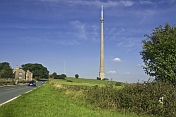 The 330m 1080 feet high Emley Moor TV transmission tower dominates nearby road and houses.. | |||||||||||||||||||||
|
Web design by gnomeplanet.com :: All images and pages on this site are © 2008 - 2024 and remain the property of gnomeplanet.com :: All rights reserved | ||||||||||||||||||||||
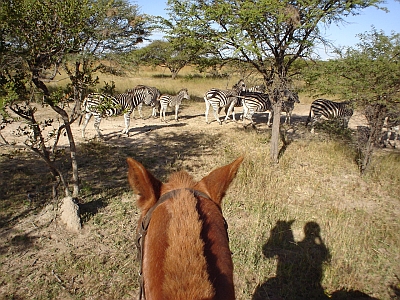 Horses are used as a regular means of transport all over the world, and can easily be hired for the day, or longer. The horse can journey where other vehicles can not, and can be 'refueled' at any handy patch of grass. It will travel at a convenient pace, is easy to control, and can carry the rider plus a suitable amount of camping equipment. When riding amongst other animals, they will generally ignore the person on the horse, so it is possible to get right in amongst game that would normally rush away from a human on foot or in a vehicle. I have ridden horses in many countries, and have taken many photographs whilst on horse-back, so felt that it might be useful to share some of my tips and techniques with other photographers intending to photograph whilst riding a horse.
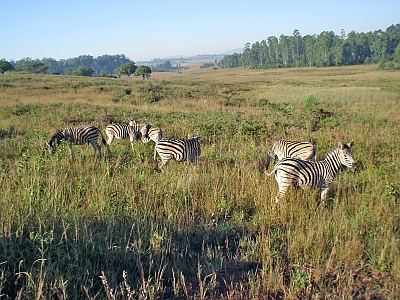 Hiring your Horse - In any area suitable for horse riding, the traveller will generally find a variety of stables that will offer horses for hire. These are generally mentioned in the more popular guidebooks, or through notices in your hotel and hostel. Unless you are a very experienced horseman, and can convince the stables of your competency, they will insist that you take a guide with you. It is therefore more cost effective to go in a group, and split the extra cost of the guide. As mentioned above, the stables will suggest a horse that they think is suitable for your level of ability, though you can request another if you think their judgement is wrong. It is worth taking a minute or two to ride the horse around the paddock to see if it responds as you expect. Once you are out of the compound you will generally be expected to keep the same horse for the duration of the ride.
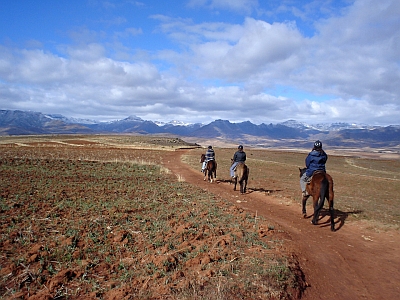 This can be done from the ground by fitting your left foot in the left stirrup, then swinging the body up and on to the saddle. The stable hands will also assist if you find this hard to accomplish. An alternative is to use a 'Mounting Block' - a small platform that makes it easy to mount the horse, although it is worth remembering that such things are unlikely to be found away from the stable complex. Once sitting in the saddle, you should check that the position of your stirrups are correct for your leg length, and the style of riding that you intend to do. Stirrups are attached to a saddle by means of adjustable straps, called stirrup leathers, and these can be lengthened or shortened as appropriate. This is done by the stable hand. If you are not sure just how long the stirrup leathers should be, but feel they might not be right for you, then bluff it out by telling the stable hand that they do not feel quite right, and go with the suggestions that they make. Here's what Wikipedia's
 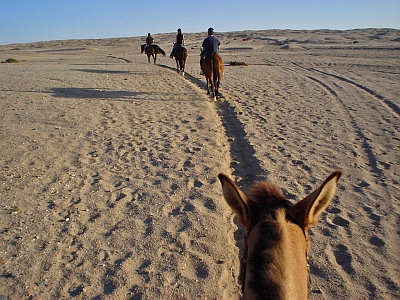 When riding an unknown horse for the first time, assume that the worst actions are likely to happen! Always enquire from the stable hands about any special things you should be aware of relating to your horse's temperament, and find out whether there are any actions or locations that should be avoided. Be aware that horses can have a definite 'pecking order', so when riding in a group you should ascertain if your horse has a particular like or dislike for its companions. Some horses always like to be near a particular 'companion', whilst at other times you will be told that certain horses should always be kept apart.


